Since deciding to become an Independent Consultant, the second most important thing after providing your clients with a high quality level of services that they expect is how do you manage the way you do your work.
A starting point is email. You need to have an email account that is most certainly not one with a free public domain. As professional, you need to pay for an email service has has a domain which represents your business and there are many available from which you can choose.
Next you start thinking about things like writing documents, analysing information and creating presentations and of course I’m talking about a Word Processor, Spreadsheet and Slide Deck set of applications and once again there are many to choose from.
Then there is how you will manage track the activities you undertake in the delivery of services to your clients and related to this is managing sales and expenses.
If we consider managing sales and expenses first, there are many online accounting applications that are cost effective and provide the accounting focussed services that are needed to run a business which takes me to the point of this article which is how are you going managing your work as an independent consultant.
Many online accounting applications provide facilities to track jobs and timesheets but this may be a simplistic view of the activities that an independent consultant undertakes in the delivery of services to their clients.
As one would expect, there are many professional services and project management applications that an independent consultant can purchase and/or subscribe to and they each have their price points which if you are running a successful consultancy will typically be an operating expense on the lower end of the scale.
As an application consulting and technical specialist with more than a decade of experience in delivering Microsoft 365 CRM and Power Platform based solutions, I couldn’t help myself but to build my own application for managing my work in delivering client services.
I am currently implementing a professional services management application that is built on Microsoft Power Apps as a Model Driven Application which I have called atiaBusiness.
As a start, atiaBusiness will be used the manage:
- Sales
- Services Agreements
- Invoices
- Expenses.
The thing that makes a Model Driven Power Apps Application well suited to managing a professional services consultancy is that it comes with Accounts and Contacts out of the box.
Accounts will be used to store information related to clients and vendors, and Contacts will be used to store information related to the people with whom you are conducting business and will be linked to the organisations represented by the Account record.
When managing a Sale, the Account and Contact will be the prospective customer that you will firstly qualified and if interested in the services that you provide, will request a quote or proposal.
Once presented with a quote or proposal, if the prospective customer is happy to proceed, returning a signed copy results in the Sale being closed as won and a Services Agreement being automatically created.
The Services Agreement will be used to store information such as the details for the scope of work, delivery timeframe and any assumptions and/or constraints. In addition, the Services Agreement will be where all consultancy effort will be recorded and forms the basis of time sheeting which is especially important for time and materials engagements. Finally, all invoicing and expenses will be recorded against the Services Agreement and its data will then be used for reporting such as Profit and Loss, Balance Sheet and Business Activity Statement.
Note that the Account and Contact records which represented the prospective customer linked to the originating Sale are now also linked to the Services Agreement and now represent an actual customer or client.
The atiaBusiness Power Apps application is currently a work in progress but there is enough of a baseline set of functionality that it could be used now.
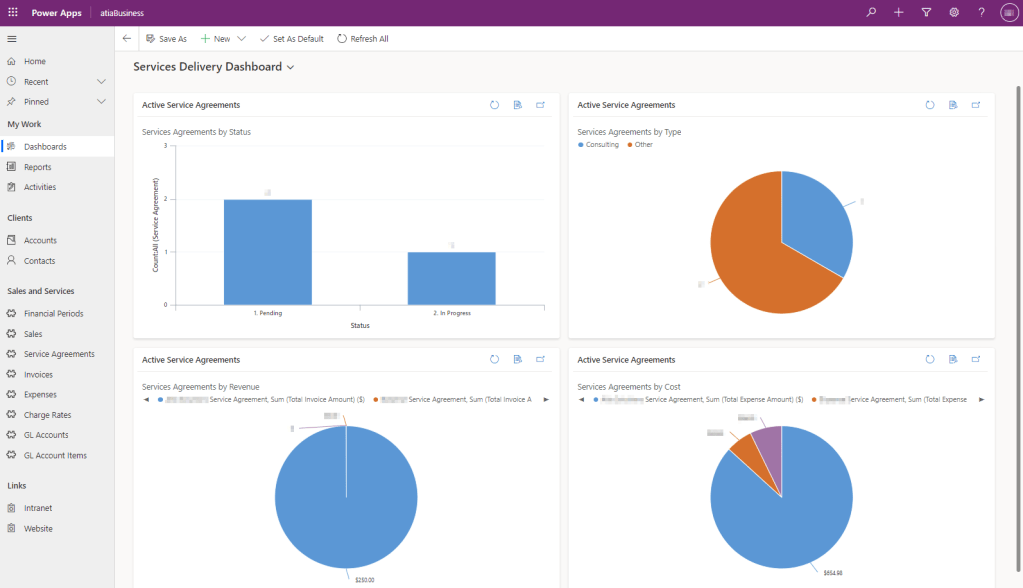
In future blog posts, I will showcase more of the atiaBusiness functionality in the context of how I am using it to manage my work as an independent consultant.
My intentions are to demonstrate the versatility of Power Platform and specifically Power Apps in building comprehensive line of business applications.
As previously mentioned, there are many online accounting applications to which you can subscribe and use it to manage your work in a generic way. The significant advantage of using Power Apps to host your business management application is that it is significantly configurable with the functionality being able to be modified to adapt to your changing business needs.
If this subject is of interest to you, then please feel free to subscribe to my blog and be notified each time I post future blog articles.
If your organisation or business has a similar need and have been considering using Power Platform, then feel free to contact me and I would be more than happy to discuss your needs in further detail.
 Atia Solutions