As we all know, Project Management is a career path that requires suitably qualified and experienced professionals to make sure that projects are delivered on time and on budget.
Professional project managers are typically Prince2 and PMP certified and as experienced individuals they are necessary for successfully delivering medium to large scale projects. These types of projects typically well funded and are resourced accordingly with roles such Business Analysts, Software Architects, Software Developers and System Testers, just to name a few.
Now let’s consider smaller projects with small budgets where the benefits and outcomes to the business are equally important as those for the larger projects with much larger budgets.
Do these smaller projects require a full service Prince2 or PMP style of project management? I would suggest not.
As an IT Professional that has worn many hats, one of my roles has been to deliver some level of project management that ensured a successful delivery and due to the small nature of the project, full service project management was not required.
Hence, this is the approach that I have taken to deliver project management that was in context with a small project but with a small budget. I would typically refer to this type of project management as Project Management Lite.
Project Management Lite as a methodology has three stages as illustrated below.
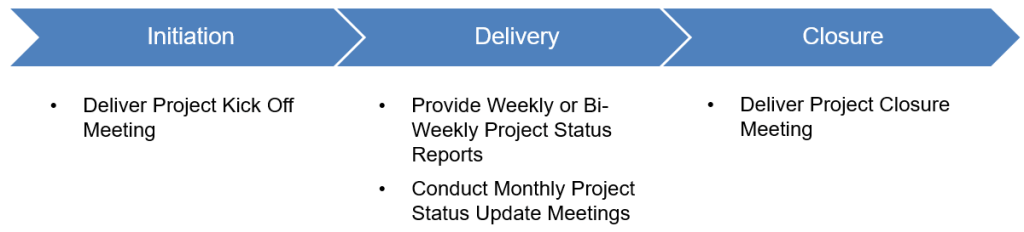
The first stage is Initiation where a Project Kick Off Meeting is held the client and has support activities like:
- Contact the client and schedule a Project Kick Off Meeting
- Prepare a presentation for the Project Kick Off Meeting.
During the Delivery stage for a project, the agreed scope is delivered as one or more project deliverables with the project management activities being:
- Preparing Status Reports and sending them to the client on a weekly or bi-weekly basis
- Meeting with client on a monthly basis and conduct a project status update meeting where the agenda can vary depending on the type of project, its scope and/or any other client specific requirements.
The final stage is Closure which is similar to Initiation in that a Project Closure Meeting is held the client and also has similar support activities like:
- Schedule a Project Closure Meeting with the client
- Prepare a presentation for the Project Closure Meeting.
The Status Report is simply a Microsoft Word (or similar) document and it should the following sections as a minimum:
- Project Performance Dashboard
- Executive Summary with supporting subsections such as “Work Completed this Reporting Period”, “Work Currently In Progress: and “Work Scheduled for Commencement”
- Project Deliverables Schedule
- Payments Schedule
- Actions Register
- Issues Register
- Risks Register
- Change Register.
The first Status Report is prepared after the Project Kick Off Meeting and sent to the client. It will typically contain the project deliverables schedule, project payments schedule and any actions identified in the kick off meeting. This first release of the status report is essentially performs the task of distributing the project kick off meeting minutes as there are generally one or more actions raised in the first meeting.
As the project progresses, with each release of the Status Report, the previous one is copied and updated as needed. In particular, if there are any issues, risks and changes that need to be recorded against the project, there is a specific register (ie. table) in the Status Report that can be updated.
As the project draws to a close, the Project Closure meeting is conducted with the client and once again, a final Status Report is updated to reflect the following:
- All project deliverables completed
- All project payments invoiced and/or paid
- All actions, issues, risks and changes closed
- The Executive Summary communicating that the project has reached a point closure
- The Project Performance Dashboard traffic lights all set to green.
Essentially. the final status report is used instead of a separate the project closure report.
A Microsoft Word (or similar) based document have may section that look like the following.
Here is an example of a Project Performance Dashboard section.
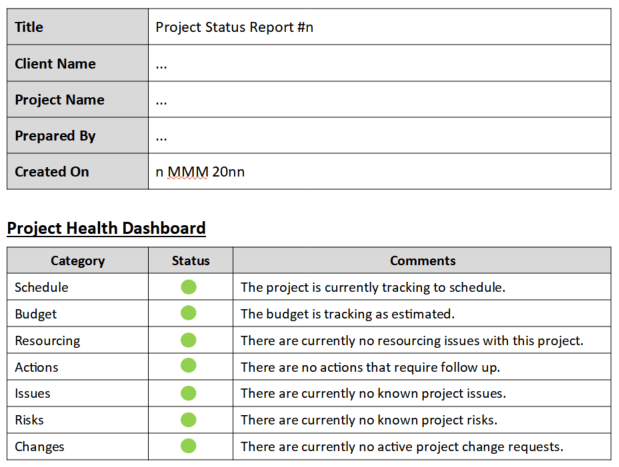
The Project Performance Dashboard should be located at the beginning of the status report following the title header section as shown above. The Status traffic light icon colour can be changed to amber and red as needed together with any supporting high level comments.
The following is an example of the Executive Summary section.
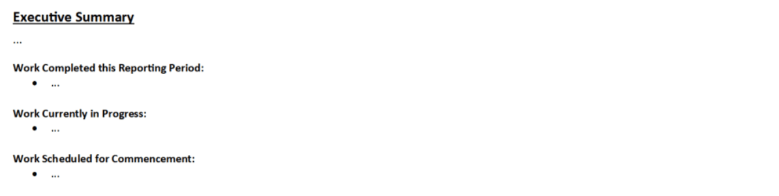
The Executive Summary is generally 2 to 3 short high level paragraphs that reports the status of the project in a concise and succinct manner. The three work related subsections will typically have bullet points that reflect a high level summary of the project deliverables.
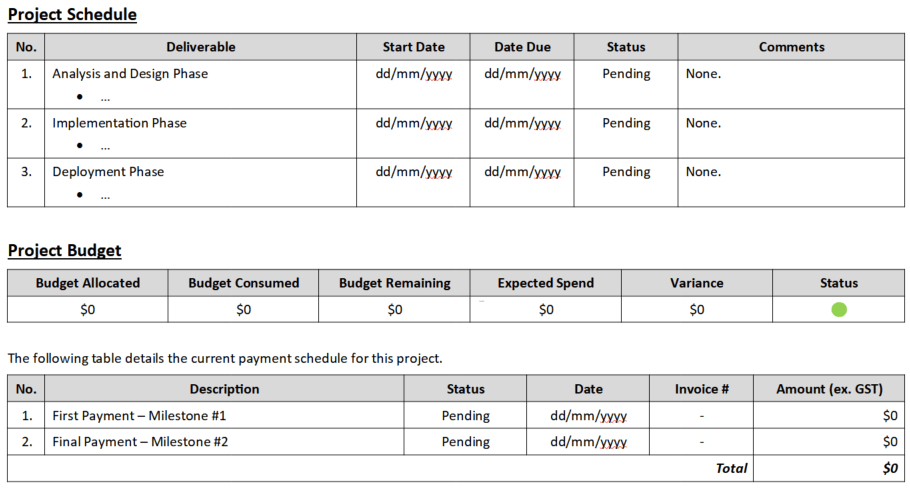
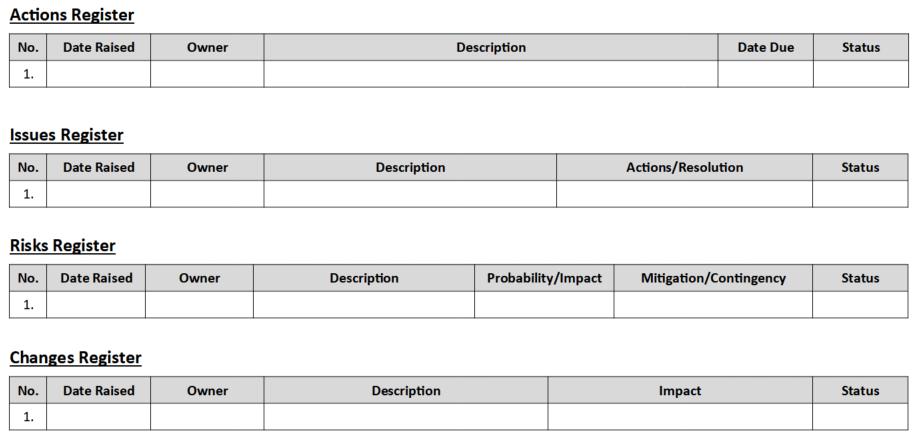
And finally there are the Actions, Issues, Risks and Change Registers as shown below.
In summary, the purpose of this article was to present a project management methodology that ensures a project is delivered successfully with all project stakeholders being kept fully informed with progress at all times and the cost and effort to provide project management being kept to a minimum.
When a medium or large project requires a full service project management delivery then that is exactly what happens.
However, Project Management Lite means that even small projects with minimum budgets will be delivered On Time and On Budget.
 Atia Solutions